
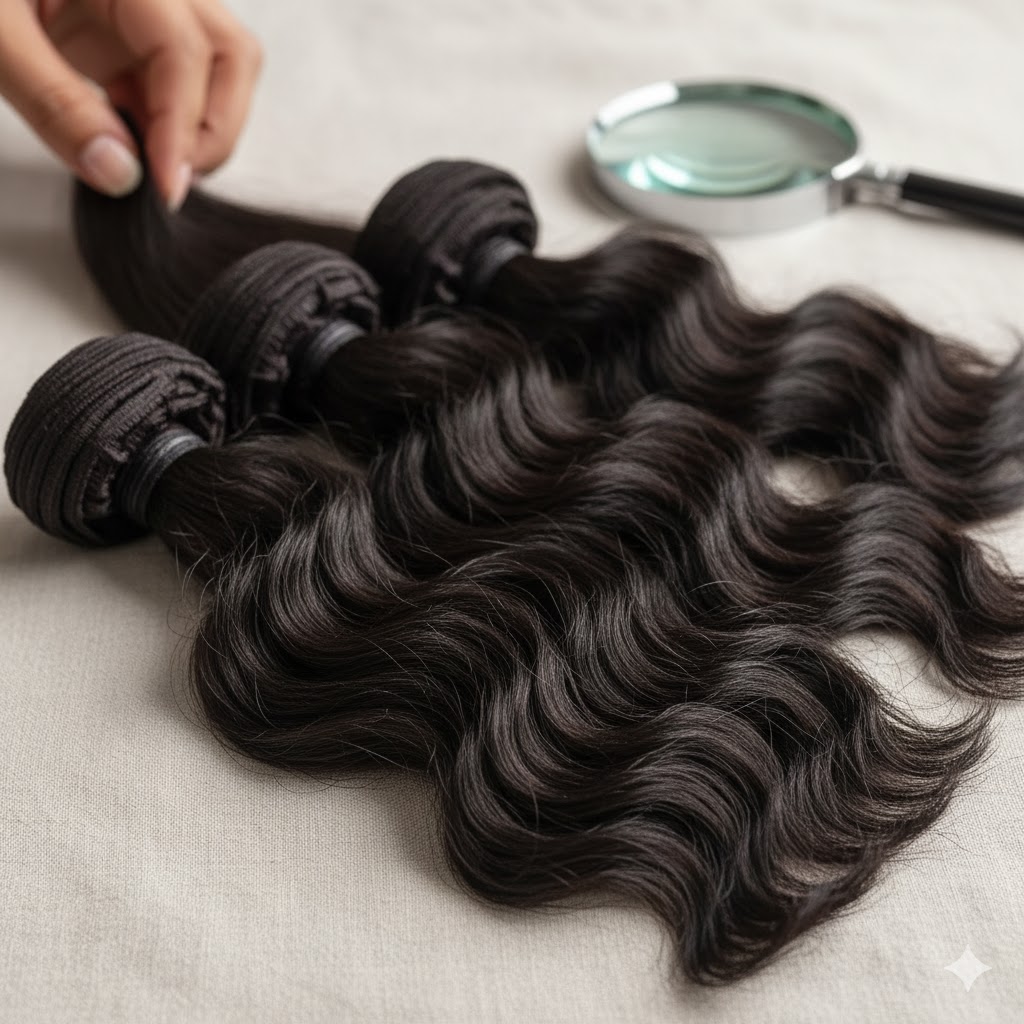
In the lucrative and often confusing world of hair extensions, two terms frequently dominate the conversation: Raw Indian Hair and “Processed Hair” (often misleadingly labeled as ‘virgin’ or ‘Remy’). For consumers making a significant investment and for professionals building a reputation, understanding the fundamental, structural differences between these two categories is absolutely crucial.
The difference in quality and performance between these two hair types reflects not just the price, but the entire history of the hair—from its source to its final state on your head. Choosing one over the other dictates everything from styling performance and coloring ability to the unit’s lifespan and overall value. Ignorance of these differences often leads to buyer’s remorse when the seemingly perfect, shiny bundle purchased at a lower price quickly degrades into an unusable, matted mess.
This comprehensive guide breaks down the real differences, providing the clarity needed to make the smartest, most reliable investment in truly premium hair.
- Defining Purity: Source, Chemical Status, and Structure
The most critical distinction between Raw Indian Hair and processed hair lies in their origin and chemical history. This foundational difference dictates all subsequent performance traits.
The Integrity of Raw Indian Hair
Genuine raw hair is the absolute purest form of extension hair available globally. It is ethically collected as voluntary donations, typically from South Indian temples. This process ensures the hair is cut directly from a single ponytail, which is vital for preserving its natural state. The chemical status of raw hair is 100% unprocessed. This means the hair has zero chemical treatments, no acid baths to strip the cuticle, no silicone coatings for artificial shine, and no harsh alkaline washes. Consequently, the hair retains its natural strength, elasticity, and protein structure, resulting in the most natural and durable extension product available, maintaining the exact integrity it held while growing on the donor’s head.
The Compromise of Processed Hair
In contrast, processed hair, even when misleadingly labeled “virgin” (meaning it hasn’t been colored), is almost always heavily industrialized. While collected from various unverified donors and often mixed together, the hair is subjected to severe chemical alteration to make the disparate strands compatible. This typically involves soaking the hair in harsh acid baths to strip and dissolve the cuticle layer. Without this stripping, the mixed, misaligned cuticles would immediately tangle. After the chemical damage, a thick layer of silicone coating is applied to mask the resulting porous, damaged hair shaft and give it a temporary, factory-perfect shine. Furthermore, these batches are often steam-textured—machine-pressed with heat and moisture—to artificially create uniform, unnatural patterns like a perfect “body wave” or “deep curly.” Structurally, the cuticle layer is stripped or severely damaged, compromising the hair’s long-term viability.
- The Cuticle Factor: Tangle Resistance and Longevity
The cuticle layer is the hair’s protective armor. Its alignment is the single most important factor determining longevity and performance, especially concerning matting and tangling.
Raw Hair: The Anti-Tangle Guarantee
Because it is collected from a single donor ponytail, the hair’s cuticles naturally face the same direction, from root to tip. This perfect alignment allows the strands to glide past each other, ensuring maximum resistance to tangling, matting, and frizz. This is the structural reason why raw hair remains manageable and smooth, even after washing and intense styling, guaranteeing its multi-year lifespan. It resists the friction that compromises lower-quality hair.
Processed Hair: The Ticking Time Bomb
When hair is collected from multiple sources, the cuticles face different directions, which naturally causes immediate friction and matting. To combat this, vendors use aggressive acid baths to chemically remove or strip the cuticles. While this solves the initial problem, it leaves the inner hair shaft exposed. The applied silicone coating provides a deceptive short-term solution, making the hair feel soft and look shiny. However, once this silicone coating inevitably washes off (usually within 1–2 months of wear), the now-exposed, damaged, and weakened hair begins to rub and tangle uncontrollably, leading to rapid and irreversible matting. The unit quickly becomes unusable, marking the end of its short life.
- Performance in the Salon: Coloring and Heat Versatility
For professional stylists and dedicated colorists, the hair’s reaction to chemical and heat treatments is the ultimate test of its quality.
Raw Indian Hair offers ultimate versatility and predictability. Since the hair is free of prior chemical residues, it absorbs color precisely and beautifully. Stylists can confidently lift raw hair to high blonde tones, like platinum, without the hair snapping or becoming excessively brittle, as its natural protein structure is fully intact. Moreover, raw hair boasts superior styling memory; it holds curls for longer periods and returns effortlessly to its natural texture after washing, proving its resilience and health.
In contrast, Processed Hair is high-risk and unpredictable. It often resists coloring due to the dense, synthetic silicone coating. Attempting to lift it to high blonde tones frequently results in severe breakage, stringiness, or melting, as the hair is already severely weakened and compromised from the underlying acid baths. This dramatically limits the creative options for the stylist.
- Visual and Wearability Differences
The visual and tactile differences between the two hair types are stark and easy to identify once you know what to look for.
Raw Indian Hair possesses a natural, low-to-medium luster, mimicking healthy biological hair; it lacks the harsh, glossy shine associated with silicone. Its texture always shows natural variation; you will never find perfectly uniform bundles, as each one is unique to the single donor. Furthermore, raw bundles exhibit a natural taper toward the ends, reflecting how hair organically grows, and the hair moves with a bouncy, free-flowing quality. The expected lifespan of this premium hair is typically two to five years with proper maintenance.
Processed Hair, however, presents an artificial, high-gloss shine due to the silicone layer. Its texture is unnaturally uniform—if you see a perfect “body wave” or “water wave” sold in bulk, it is a machine-set texture. The ends of processed bundles are often unnaturally blunt and full, an indication that short filler hairs have been mixed in. This hair often feels stiff and lacks the authentic bounce of raw hair. Its longevity is severely limited, typically lasting only one to eight months before the severe tangling begins.
Conclusion
The real difference between Raw Indian Hair and processed hair is not a slight variation in price, but a massive gap in integrity. Processed hair offers an initially appealing look but is structurally compromised, delivering a short-term solution with poor return on investment.
Choosing authentic raw hair, however, is an investment in ethical sourcing, superior natural structure, and guaranteed multi-year longevity. For consumers and professionals alike, opting for raw ensures you receive a premium, high-performing product that maintains its value and beauty for years, making it the most economical and satisfying choice in the long run.